Common Skin Concerns During Dry Seasons: Dryness, Sensitivity, and RednessWaking up with a tight, dry face in the morning
・Feeling skin tightness right after a bath or shower
・Experiencing itching or redness in the same areas prone to dryness
・No visible peeling, but an uncomfortable stinging sensation persists
People with sensitive skin often struggle with dryness and redness.
They have tried various skincare products and skincare items recommended in magazines and on social media, yet their concerns remain unresolved. Some even come to believe that experiencing these symptoms is normal for their sensitive skin and that improvement is impossible as this is the character of their skin.
I also faced many challenges before I have created my current skin that doesn’t frequently suffer from flare-ups. I tested numerous skincare items and skincare routines, and it took a lot of effort to see real improvements in my skin condition.
Skin Barrier Function
In the past, media often introduced methods for improving skin condition by using luxury creams. However, in recent years, there has been a growing focus on the importance of skincare that firmly defends against external stimuli.
The reason is that healthy skin naturally contains moisturizing components and has the ability to maintain hydration.
By mixing with the skin’s own secretions, it can create a surface that doesn’t easily dry out.
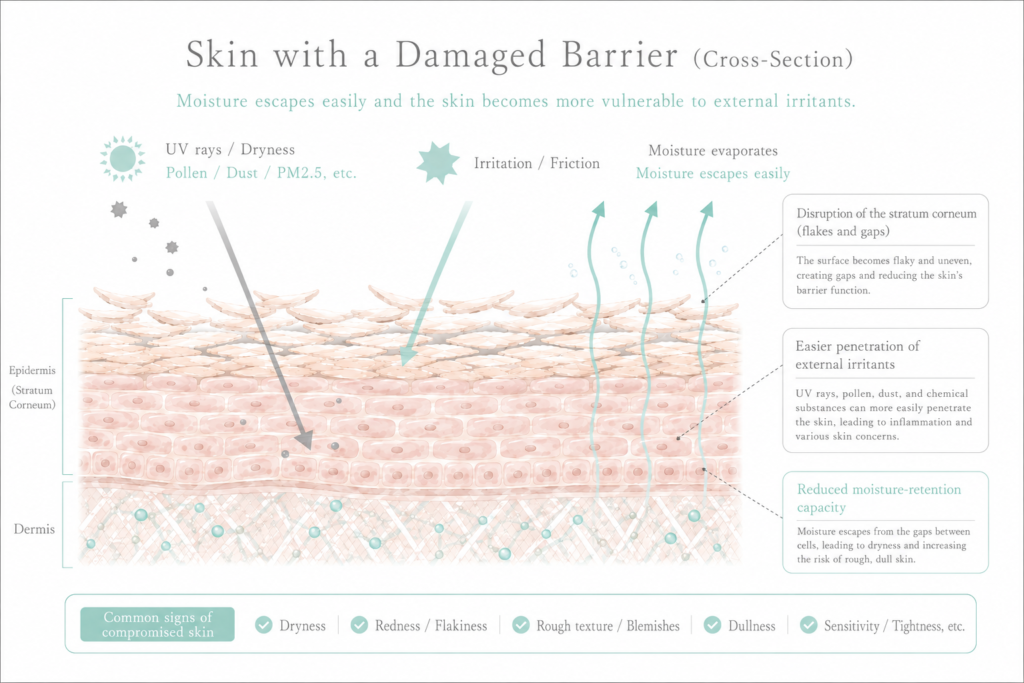
So, why has the skin’s natural moisturizing power become depleted?
It is because the “barrier function” and the skin’s ability to retain moisture have been deteriorating.
Excluding congenital factors, for those who feel dryness from a young age, improving the “barrier function” will also accelerate the improvement of concerns such as dry, sensitive, and redness-prone skin. In the other words, barrier-damaged skin may lead to these skin conditions.
Nowadays, many people start using makeup and sunscreen from junior high or high school, and often use strong surfactants from a young age. As a result, the number of people with sensitive skin and weakened barrier function is increasing.
So, how can we nurture this barrier function?
We shall go through the key points one by one.
What is the “Barrier Function” that protects the skin from external stimuli?
Recently, the term “barrier function” has become more common in magazines and commercials. This refers to the natural protective function of the stratum corneum on the skin’s surface, which shields the skin from external irritants.
What is the role of our skin?
- Protects against external stimuli
- Maintains a stable body temperature
- Functions as a sensory organ
- Acts as a secretory organ
Among these, the skin’s barrier function specifically serves to protect against external stimuli.
For example, imagine having a small crack on your hand and rubbing salt into it—it hurts a lot, doesn’t it?
Yet, when your skin is healthy, holding a salted rice ball doesn’t cause pain. This is because the skin’s barrier function is protecting it from irritation.
When the barrier function is damaged for any reason:
If the barrier function is weak and easily damaged → Sensitive skin
Internal moisture evaporates, leading to redness and dryness → Dry or red skin
So, what should we do to build up the skin’s barrier function?
1. Don’t Damage
Irritations that harm the skin barrier can be divided into:
- Physical irritations. ex) Extraction, scrub etc
- Chemical irritations ex) Skin peeling, scrub etc…
Our facials provide ‘Skin Regeneration Program’ that does not apply any physical or chemical stimulation.
Skin Regeneration Program is only available at KI Day Spa Tokyo.
Skin generation program is to send a signal to skin basement to grow the cells and create healthy skin turnovers.
2. Strengthen
Enhance the skin’s barrier function with consistent daily skincare routines.
3. Repair
If the barrier function becomes weakened, take action to repair it before it is completely damaged.
At KI Day Spa, our skincare experts provide thorough consultations to understand your skin condition and daily skincare routine. Based on this, we propose tailored solutions for improvement. Each customer has different priorities for what should be addressed first, and our experienced therapists will offer recommendations grounded in dermatological science.